
Winter bills have a way of arriving like a verdict. And if one room in your home never warms up, the temptation is always the same: push the thermostat up a few degrees and let the furnace work harder for every room in the house. A space heater looks like the cheaper fix — but how much does it actually cost to run one? Here is the plain math, the myth worth ignoring, and the habits that genuinely keep one room warm for less.
The short answer
Running cost = watts ÷ 1,000 × hours × your electricity rate. At a typical US rate of about 17¢ per kWh, a 1500 W heater costs about 26¢ an hour and an 1800 W heater about 31¢ an hour while running flat out — less in practice, because the thermostat cycles the heat once the room is warm. Every electric heater is about equally efficient, so the real savings come from heating only the room you’re in, with the door closed, and turning the central thermostat down.
The formula: three numbers and a calculator
Your utility bills you for kilowatt-hours (kWh). A heater’s wattage tells you how fast it uses them (to measure your own heater’s real use and your room’s temperature, see how to measure room temperature correctly):
- Convert watts to kilowattsDivide the heater’s wattage by 1,000. A 1500 W heater is 1.5 kW; an 1800 W heater is 1.8 kW.
- Multiply by the hours it runs1.5 kW for 8 hours is 12 kWh. That is the most it can use in that time.
- Multiply by your rateFind the price per kWh on your electric bill (including delivery charges). 12 kWh × $0.17 = $2.04.
What common heater sizes cost to run
At about 17¢ per kWh, running continuously at full power:
| Heater power | Per hour | 8-hour evening | 30 evenings |
|---|---|---|---|
| 750 W (low setting) | ~13¢ | ~$1.02 | ~$30.60 |
| 1500 W | ~26¢ | ~$2.04 | ~$61.20 |
| 1800 W | ~31¢ | ~$2.45 | ~$73.44 |
These are worst-case figures. A heater with a thermostat stops heating once the room reaches the set temperature and only cycles back on to hold it, so in a closed, reasonably insulated room the real number is usually well below the table. Rates vary a lot by state; use the figure on your own bill.
The myth: “energy-saving” heaters
You will see heaters sold as if they create more heat from the same electricity. They don’t. Electric resistance heating — ceramic, oil-filled, coil, infrared — converts essentially all of the electricity it uses into heat; the U.S. Department of Energy describes it as 100% efficient in exactly that sense. A watt is a watt.
So where does the saving come from? From heating less space for fewer hours. A furnace warms every room in the house, used or not. A room heater, used well, lets you turn the furnace down and warm only the room where people actually are. The Department of Energy estimates you can save as much as 10% a year on heating and cooling simply by turning your thermostat back 7–10 °F for 8 hours a day — and a room heater is what makes a lower central setting comfortable.
8 ways to heat one room cheaply
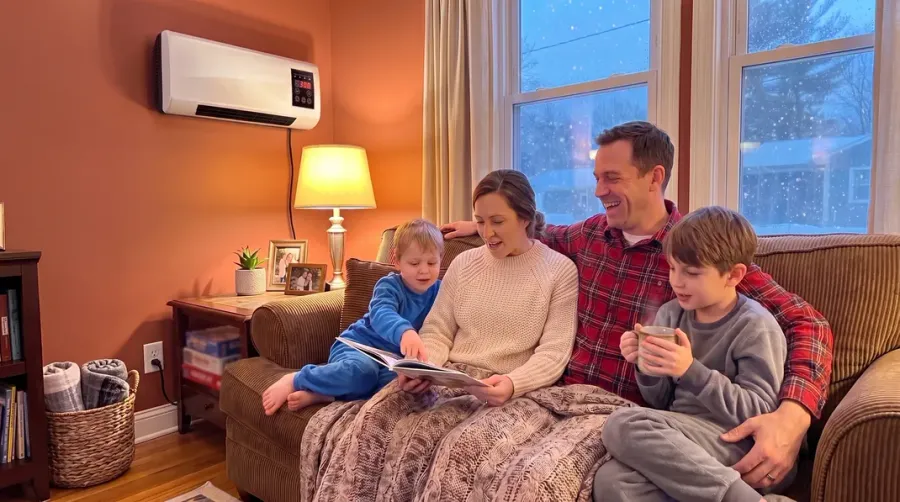
- Turn the central thermostat downThis is where the money is. Drop the house a few degrees and let the room heater handle the one room you’re in.
- Close the doorYou’re paying to heat one room. Don’t let the warm air leak into the hallway and the rest of the house.
- Use the thermostat, not “max”Set a comfortable target and let the heater cycle. Running flat out all evening is how the worst-case numbers above happen.
- Use a timerWarm the bedroom before bed and let the heater switch itself off after you fall asleep. Hours you don’t run are hours you don’t pay for.
- Start on high, then drop to lowA burst of high heat warms a cold room quickly; a lower setting is usually enough to hold it there.
- Seal the obvious draftsA draft stopper under the door and weatherstripping on a leaky window keep the heat you paid for in the room.
- Put the heater where the heat spreadsA unit mounted up on the wall with a fan pushes warm air across the room instead of warming the carpet in one corner.
- Turn it off in empty roomsNever leave a heater running in a room nobody is using — it wastes money and it isn’t safe.
When a room heater won’t save money
A space heater is not magic. If you run one in addition to a fully heated house, your bill goes up. If you use it to heat a large, open-plan space with the doors open, it will run constantly. And if you need several rooms warm all day, central heating is usually the better tool. The winning pattern is simple: one closed room, a lower house thermostat, and a heater with a thermostat and timer. (Wondering which heater type suits your room? See ceramic vs. oil-filled vs. infrared heaters.) And if the cold is wearing on you as much as the bill, read how a cold house affects your mood.
Our recommendation: Power Heat Pro
If you want a heater that makes the “one warm room” strategy easy, the Power Heat Pro is the one we recommend. It’s an 1800 W PTC ceramic heater that hangs on the wall on its included bracket or stands on a desk, and it has exactly the controls that keep running time in check: an adjustable thermostat that holds the temperature you set, Low Heat and High Heat modes plus a Fan-only setting, an auto-off timer in 1-hour steps and a remote control. At full power it draws like any full-size heater — the savings come from using it the smart way described above, and its controls make that effortless.
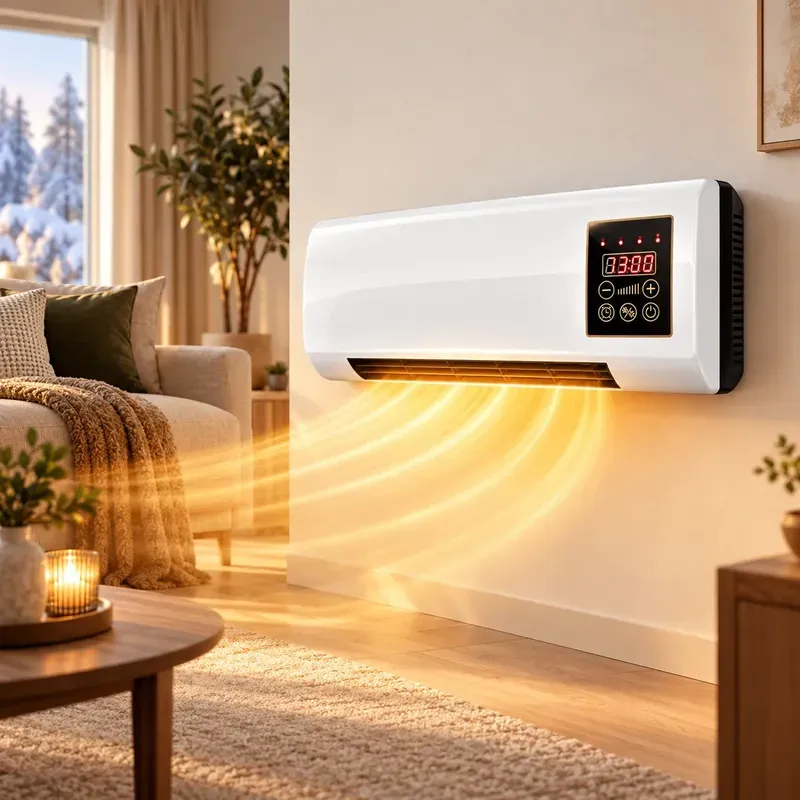
- Thermostat built in: set TEMP and it cycles to hold the room there instead of running flat out.
- Timer in 1-hour steps: warm the bedroom before bed and let it switch itself off.
- Low Heat for holding, High Heat for warming up: exactly the “start high, drop to low” habit.
- Heat that spreads: mounted up on the wall, its fan pushes warm air across the room.
On the official checkout (checked November 15, 2026), one Power Heat Pro is $99.99 and the two-pack works out to $79.99 per unit ($159.98). Every order is covered by a 30-day money-back guarantee, and the maker advertises fast shipping. Turn the house down a few degrees, close the door, and let it warm the room you’re actually using.
Want every detail first? Read our full Power Heat Pro review — specs, controls, scorecard and verdict.
Frequently asked questions
How much does it cost to run a 1500 W space heater for 8 hours?
At about 17 cents per kWh, a 1500 W heater running flat out uses 12 kWh in 8 hours, which is about $2.04. In real use the thermostat cycles the heat once the room is warm, so the actual cost is usually lower. Check the rate on your own electric bill and multiply it by the kWh used.
Is it cheaper to run a space heater or central heating?
Heating one room with a space heater is usually cheaper than raising the central thermostat for the whole house, because you are heating far less space. The savings come from turning the central heat down a few degrees and warming only the room you use; running a space heater in addition to a fully heated house adds to the bill.
Are some electric space heaters more energy-efficient than others?
Not in the way ads suggest. Every electric resistance heater — ceramic, oil-filled, coil or infrared — turns essentially all of the electricity it uses into heat, so a watt is a watt. What changes the bill is how many watts the heater draws, for how many hours, and how well its thermostat and timer stop it from running longer than needed.
Does a space heater use a lot of electricity?
A full-size space heater is one of the bigger loads in a home while it runs: 1500–1800 W is about as much as a hair dryer or microwave, but for hours instead of minutes. That is why a thermostat, a timer and heating a closed room matter so much.